My Memory of the Last Time I Saw Iris Chang
By Da Hsuan Feng
Da Hsuan Column
May 26, 2018
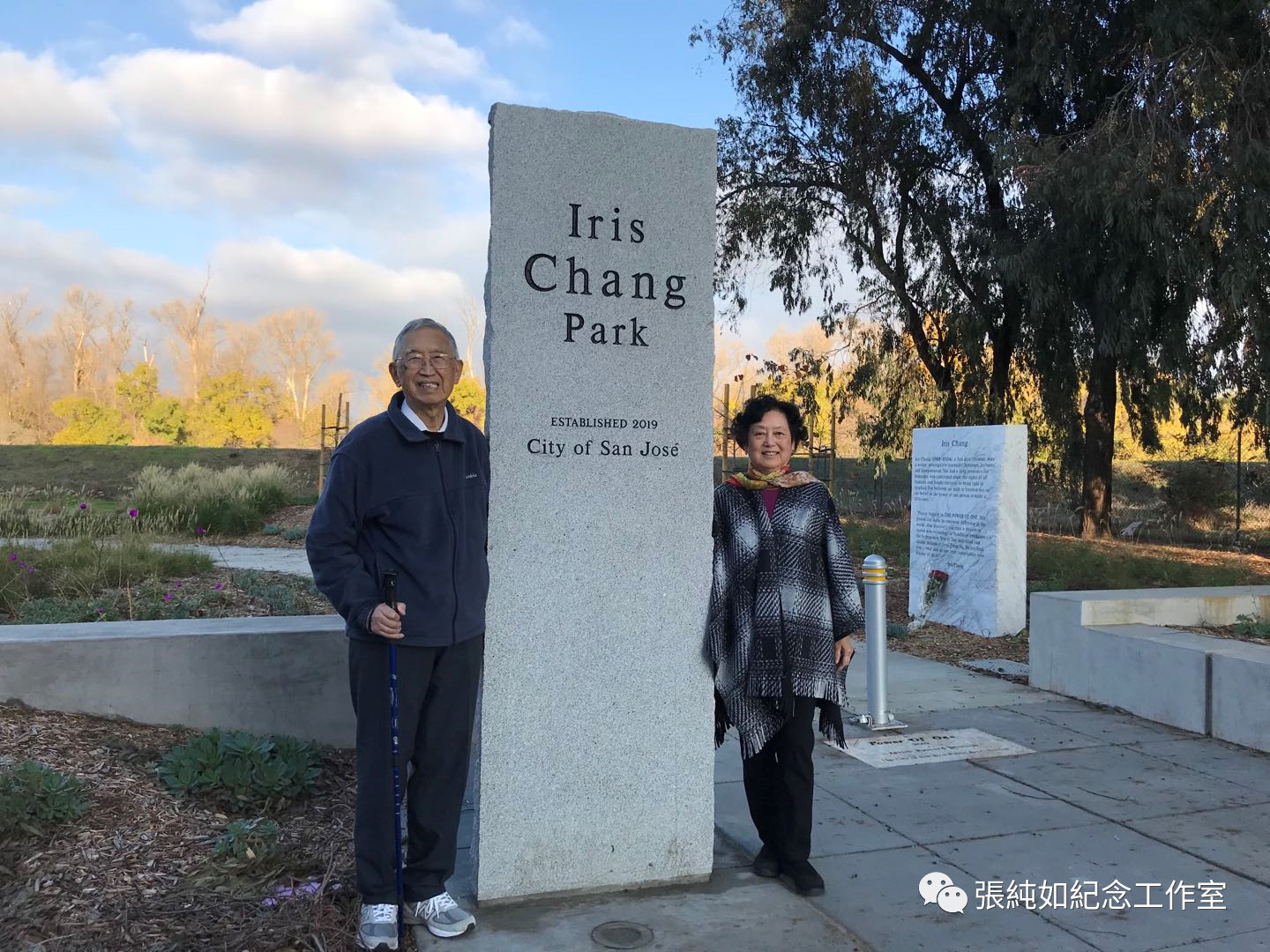
Two days ago, someone on Facebook noted that it was Holocaust Remembrance Day. The two words I associate with that day I first heard fifty years ago, when I was a new arrival in America: Never Again. Reading the post took me back to 2004 — to the Chinese-American community in Richardson, Texas, just outside Dallas, where I had the privilege of meeting Iris Chang.
Iris Chang was a Chinese-American writer of extraordinary reach. The book that made her name, and that struck readers all over the world, was The Rape of Nanking. The book set down, in plain and unsparing detail, what had been done to the city of Nanjing during the Second World War.
On April 1, 2004 — April Fool’s Day — the Chinese-American organizations of Texas had invited her to Dallas to speak. I was at the time the Vice President for Research at the University of Texas at Dallas, and the local Chinese-American community honored me by asking me to introduce her before her lecture. I was glad for another reason as well: Iris Chang’s father, Shau-Jin Chang, is a distinguished theoretical physicist, and as a colleague I had had the chance to know him a little.
The Chinese translation of my introductory speech is attached below.
April 1, 2004 was the second time I met Iris Chang. As I said goodbye to her that night, we exchanged a few sincere words. I did not know then that those words would be our last. Rest well, Iris Chang.
Thank You, Iris Chang
Introducing Iris Chang
A speech delivered in Richardson, Texas, near Dallas — April 1, 2004
By Da Hsuan Feng — Vice President for Research, University of Texas at Dallas
Ladies and gentlemen, good evening.
As a writer of profound and global influence, Iris Chang needs no introduction. And precisely because she needs none, what I find I can truly say here is one word, said from the heart: thank you.
In 1964, when I was a freshman newly arrived in New Jersey, a classmate invited me to a lecture on campus. He told me the speaker was a survivor of the Holocaust. I had never heard the English word before.
To this day, that lecture and the photographs that accompanied it are burned into my memory — they are something close to a wound. There was nothing human in those photographs. I remember clearly the last two words the speaker said: Never Again.
That night I went back to my room and I could not stop thinking about that English word, Holocaust. I wondered whether the word could only be used for what the Jews of Europe had endured — that ordeal of mind, body, and soul.
I took my Cambridge dictionary off the shelf, and the entry read:
“The Holocaust” was the systematic murder of many people, esp. Jews, by the Nazis during World War II.
Reading that, I understood for the first time that the word Holocaust could be used for any massacre.
After the Second World War, my mother taught music at Ginling Women’s College in Nanjing. I remember she once told me, very briefly, about the Nanjing Massacre. But the events were so terrible that she would not — could not — speak of them in any detail. After hearing what little she said, I was filled with anger, and at the same time with a feeling of helplessness, because there was nothing then in my reach that could let me understand what had really happened in Nanjing.
Slowly I let the matter drift to the back of my mind. What brought it back, years later, was reading Iris Chang’s The Rape of Nanking.
The book made it clear to me that, although I am not a Jew, I could feel the same anger and stand in solidarity with the Jews who suffered during the Second World War. The book made it clear to me that the Jews and I — we — are one human family.
I have come to believe deeply that anyone who reads Iris Chang’s book — whether Chinese or not — will feel the same anger.
Iris Chang’s book is a cry for justice on behalf of the countless people who suffered horribly in Nanjing.
And so, however small I am, I would like to speak on behalf of all of humanity, and say to you, Iris Chang: thank you.
(Da Hsuan Feng — Da Hsuan Column, May 26, 2018. Compiled by Zoe Sheng and Lily Yao.)