By Ying-Ying Chang
When I think back to the making of the documentary Nanking, I am forced to say that, in this world, there are some things that happen in ways stranger than we can account for.
After our daughter Iris Chang took her own life on November 9, 2004, my husband and I fell into the deep end of grief. For a year we shut ourselves in the house, did not step out, and could not pull ourselves up. Iris’s death brought us a sorrow without limit; it also brought, to many people we had never met, the act of remembering her. But what I never expected was that there was a man who, like us, could not let her death and the story she had laid down in The Rape of Nanking go from his mind. For weeks the book turned over and over inside him, and at last he resolved to bring the story of the Nanjing Massacre to the screen.
Early in October 2005, I received a letter from a man named Bill Guttentag. He wrote that he was a documentary director in Hollywood, and that he was preparing to make a film about the Nanjing Massacre. He said he held Iris and her work in deep respect, and asked us to help him. I went straight to the internet to find out who he was. It turned out he was an Oscar-winning documentary director — and at once a feeling of respect arose in me. While Iris was still alive, she had hoped that the history of Nanjing might one day reach the screen; now someone had come forward, on his own, to do it. We could not have hoped for better news, and of course we would help him see it through. Bill arranged to meet my husband and me in a coffee shop near the Stanford campus. We went, as we had agreed. It turned out that Bill not only worked in Hollywood; his home was near Stanford, because he was also a professor there, teaching courses in film. The man sitting across from us with a cup of coffee in his hands struck me, the moment I saw him, as the scholar-gentleman type, with a neatly trimmed white beard around his lips, and not a trace of the bigness of a director — which set my husband and me at ease.
Bill told us, slowly, how he had come to take on the Nanjing project. There was, on the East Coast, a wealthy man named Ted Leonsis, who, having been moved by Iris’s book, wanted to put up the money to make a film about the Nanjing Massacre. Ted wanted to hire Bill to direct it; Bill, feeling that the subject was almost impossibly difficult, declined. Ted then flew Bill from California to Washington, D.C., on his private plane, and invited him to attend a game played by his sports team. Faced with that kind of sincerity, Bill could not refuse, and accepted. He had already assembled a production team and read Iris’s book carefully. He and the team were about to leave for China to interview survivors, and he asked us to give the team our help. We agreed at once. Once home, I went straight back to the internet to look up what I could find about Ted.
Ted Leonsis turned out to be a Greek-American — a self-made man with a touch of legend in him. His parents were both working-class; his father had hoped that, when Ted grew up, he might do well to find a job in a restaurant. But Ted had learned, from a young age, how to work hard for his own keep. In summer he mowed the lawn of a man who worked in the stock market; that man, seeing Ted’s diligence and intelligence, helped him get to college. Ted graduated from Georgetown University in Washington — the first in his family to attend college. By his industry and his shrewdness, he rose without much resistance to the rank of vice president of America Online (AOL), came to own several professional sports teams, and his net worth eventually crossed into the hundreds of millions. When he was twenty-six, he had survived a plane crash, and that brush with death was a turning point. He decided that, with the rest of the life that had been given back to him, he would do something. That decision became the engine that powered everything afterward. He drew up a list of one hundred and one things he wished to accomplish before he died — and one of them was to make, in his lifetime, a film. After his rise, his wishes began, one after another, to be fulfilled.
After we met Bill in October 2005, I gave Bill’s assistant, Violet Feng — who served as the documentary’s associate director — every piece of material we had at home about the Nanjing Massacre, including a great many video tapes, and the entire body of recordings of Iris’s interviews. I also reached out to the directors of the Global Alliance for Preserving the History of WWII in Asia — Ding Yuan, He Yingming, Shao Zhengyin, and others — and everyone gave Bill’s team what materials they had. I helped them to reach Zhu Chengshan, the director of the Memorial Hall of the Victims in Nanjing, so that Bill’s team could quickly meet survivors. The shoot in China went smoothly. Bill kept up his correspondence with me throughout, and thanked us, again and again, for the steady support of the Alliance.
In October 2006, the Global Alliance held its biennial conference, that year hosted by the Washington, D.C. chapter. After Iris’s death, because of her close ties to the Alliance, my husband and I had joined it, and we attended the meetings in Washington. Through Bill’s introduction, I had been writing to Ted, who lived in Washington; we agreed to meet at the conference. So it was that, for the first time, we met Ted in person. The moment he saw us he came forward with his hand outstretched. Ted was tall, broadly built, with dark hair and brows and bright eyes — the cast of an Eastern European face. At the conference he introduced unedited footage from Bill’s shoot in Nanjing, and asked the chapters of the Alliance, once the film was finished, to help with its promotion. At lunch, he made a point of asking that he be seated with us. Because the Alliance worked on a tight budget, the venue was a modest hotel; the lunch table was small, and Ted sat directly across from us, less than three feet away. Mild and courteous, he turned to my husband and me and explained why he had decided to make this film.
Ted said that, at Christmas of 2004, he had been on his private yacht in the Caribbean. There was nothing on board to read, so when the yacht moored at a small island, he bought up a great stack of back issues of The New York Times to read at his leisure. Among them, he came upon the obituary of Iris from November 2004, with her photograph beside it. He said he considered himself a reasonably well-read, reasonably educated man — and yet, until that moment, he had never heard of the Nanjing Massacre. The obituary mentioned Iris’s book The Rape of Nanking, the Nanjing Safety Zone, John Rabe and the international group within the Zone who had saved 250,000 refugees. None of this was familiar to him. From that moment, the history of Nanking gripped him. Before disembarking, he saw the servants tossing the old papers into the trash; the page with Iris’s obituary happened to be on top. As he passed the bin, he found that Iris’s eyes, in the photograph, were following him. He paced back and forth, and her eyes paced with him. As Ted said this, the hairs on my arms stood up. I looked at him intently — there was no trace of exaggeration. Ted said, in earnest: those international humanitarians of the Safety Zone could have, in those dangerous wartime conditions, walked back to a comfortable life in their home countries. Instead, they chose to stay and save refugees. The depth of their humanity was beyond what we owe them in respect. He said: In the darkest hour, there is always one ray of dawn — which became the slogan of the documentary Nanking. And then, pointing at his own chest, he asked: “In their place, would I have stayed?” That question, he said, had been pressing on him without rest. As he spoke, I was deeply moved.
Ted went on: “When I got back home, I went to the bookstore and bought every book I could find on the Second World War, and read them through.” He read Iris’s book through and through. For a long stretch in those days, he said, the history of Nanjing followed him everywhere, and he could not put it down. He could not sleep for nights. His wife told him: “I have never seen you so absorbed in anything.” He spoke to us with such candor and such openness about what was inside him. He was warm, just-minded, and approachable. Not a trace of the rich man’s manner — in fact, talking with him, I forgot completely that he was one of the great men of business, the owner of three sports teams in Washington, of a private plane, of a yacht. And so it was that he made the documentary Nanking the answer to one of the wishes on his list: to make, in his lifetime, a film. He put up a million dollars and engaged Bill, the great director, to make it. He said: if it was to be made, it had to be made well — and so he wanted the best, the first-rank director.
By early 2007, Bill had finished cutting the film. He was, as one would expect from an Oscar-winning director, capable of fresh approaches. He invited a number of well-known Hollywood actors of the day, who agreed to work pro bono. I imagine Bill persuaded them by appealing to the spirit of the humanitarians of the Nanjing Safety Zone. Each actor took on the role of one of the international figures inside the Zone, reading aloud from their letters and diaries, which described the suffering of those weeks. Jürgen Prochnow took the role of John Rabe; Woody Harrelson, Dr. Wilson; Mariel Hemingway, Minnie Vautrin.
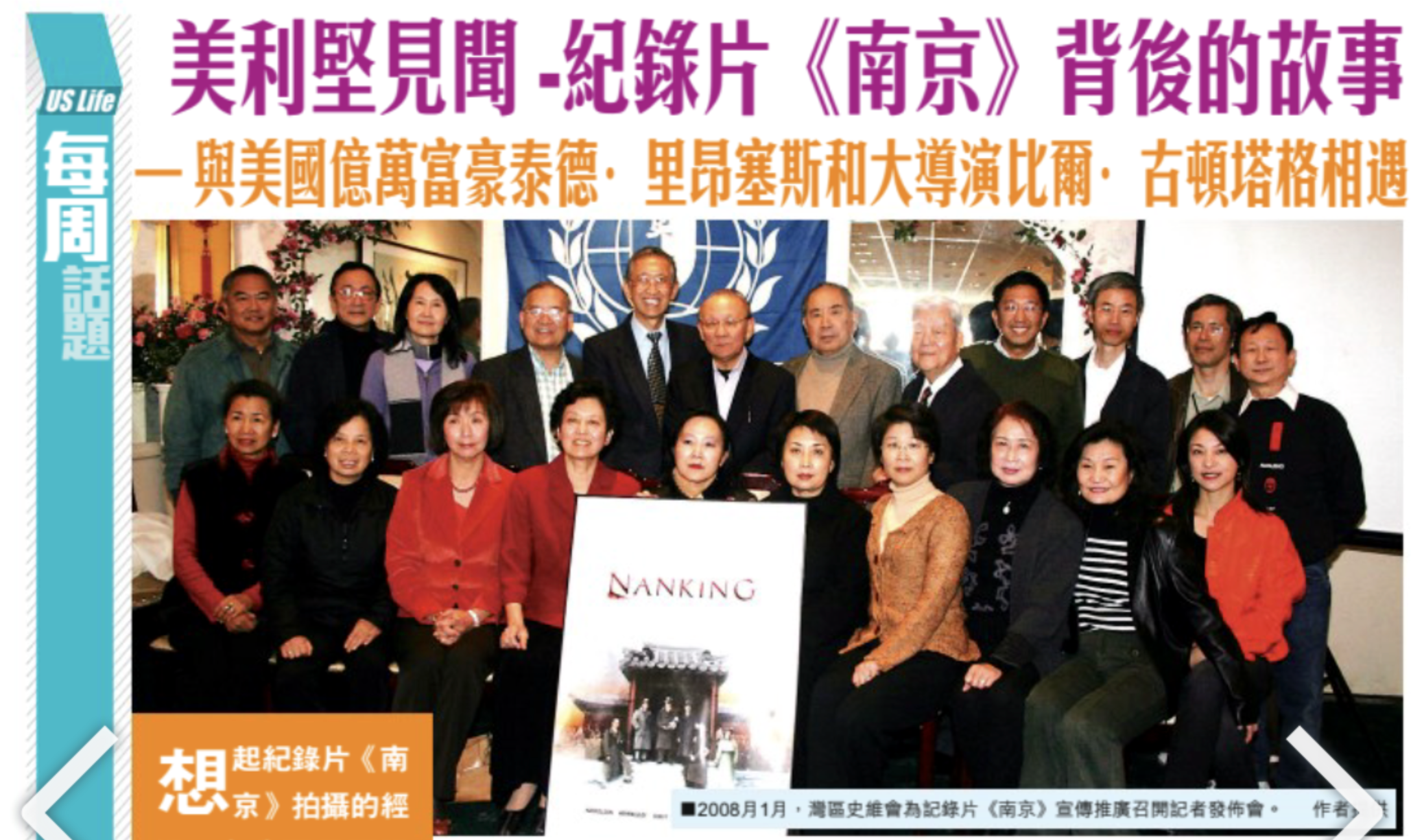
The documentary Nanking was completed in 2007. At the Sundance Film Festival in Utah it received high praise. At that year’s Academy Awards it did not, as Ted had hoped, win Best Documentary, but it was one of the five finalists nominated. It also received the Peabody Award — the highest honor in artistic creation. We and the Alliance worked hard to publicize and promote Nanking, and the film was screened across North America, across Asia, and on the Chinese mainland; its impact on the public understanding of this history has been considerable. At the very end of the film, there is a special remembrance of Iris Chang, with thanks for what she did to bring this history forward. I believe Iris, wherever she may be, is comforted by it.
A small story: in November 2007, Ms. Ma Difan, a leader of the Boston Chinese community, wished to hold a public screening of Nanking in Boston, and to invite Mr. Leonsis to introduce the film. I gladly agreed to help her invite him. When Ms. Ma wrote to him, she said that she would cover his travel costs and arrange airport transfers. Ted wrote back that she should not worry about it. Only afterward did we remember he had a private plane. Ms. Ma and I laughed on the telephone for a full two minutes.
My encounters with Ted and Bill on the road of life were brief; but I will never forget the story behind this film. How many in this world feel, as Ted did, the sacrifice of those humanitarians inside the international Safety Zone of Nanjing? And how many would be willing to put up the money to make a film to bring this history to the public? When I think back to Ted saying that Iris’s eyes had followed him, that they had taken hold of his heart — was that what religion calls a miracle? Was it what science calls telepathy? Was it accident? Or fate? Or is it that only those who carry the right kind of attention can catch hold of those mysterious instants? It is a phenomenon that, in this world of ours, will never be fully explained.
- Ying-Ying Chang is the mother of Iris Chang. She holds a Ph.D. in biochemistry from Harvard University and is a retired research associate professor of microbiology at the University of Illinois. In 2011 she published her English memoir of her daughter, The Woman Who Could Not Forget. The Chinese translation, Iris Chang: The Woman Who Could Not Forget History, was published in both simplified and traditional editions in 2012.