By Ying-Ying Chang
Richard Rhodes — the famous author of The Making of the Atomic Bomb — once wrote a review of The Rape of Nanking, our daughter Iris Chang’s book. That he would also write the foreword to my own memoir was, in my life, an episode I had never expected.
The film Oppenheimer won seven Academy Awards this year, and has been the most discussed film of the past several years; many viewers and critics have written about it, and the discussion online has been considerable. Oppenheimer was adapted from American Prometheus: The Triumph and Tragedy of J. Robert Oppenheimer, by Kai Bird and Martin Sherwin. But many readers may not know that, in 1987, Richard Rhodes’s The Making of the Atomic Bomb was, before that, the canonical and systematic account of the entire process of building the bomb — including, of course, the Manhattan Project and Oppenheimer himself. The book made an immediate impression when it appeared, won the 1988 Pulitzer Prize for nonfiction, the National Book Award for nonfiction, and the National Book Critics Circle Award. Rhodes became famous overnight. To date he has published twenty-eight books. After The Making of the Atomic Bomb he wrote three more books, all on nuclear weapons, completing the series only in recent years. The Nobel laureate I. I. Rabi, one of the early figures of the atomic age, called the book “a Miltonic epic. I have nowhere else seen the whole story told with such elegance and passion, with so much illuminating detail, and with such simplicity, leading the reader through brilliant and profound scientific discoveries and their applications.” Physicists have long recommended it to ordinary readers as the best account of how the atomic bomb came to be. According to a recent piece in The Atlantic, AI engineers today still carry the 900-page book back and forth.
When Iris published The Rape of Nanking in 1997, the publisher invited Rhodes to review it — both because he was, like her, a student of the Second World War, and because Japan’s invasion of China had ended with the dropping of two atomic bombs, a subject not far from his field. Rhodes wrote of The Rape of Nanking: “A powerful, landmark book, whose horror draws the reader in.” After that review, Iris and Rhodes both said, on different occasions, that they had become friends and had met. I knew of the friendship, but had no particular impression of Rhodes — until, after Iris’s death, when I had begun to write a memoir of her, I came back, among the letters Iris had sent us, to a particular one in which she had written about Rhodes, and which now caught my attention.
Iris’s letter to me, October 27, 1999:
“Dearest Mom — it was wonderful to talk with you and Dad on the phone a few days ago. There are very few people in this world whose families are like ours, where parents and children love each other and stay in touch almost every night. Heaven really has watched over us, and we must remind ourselves of that every day. So many of my friends do not enjoy speaking with their parents — many simply do not speak with them at all. … And there are many who have no idea who their mothers really are. The other day, after I had had lunch with Richard Rhodes, I quickly turned through his autobiography, A Hole in the World. As you know, when Rhodes was a child his stepmother starved him, beat him, and tortured him in spirit (his mother shot herself; his father turned alcoholic and could not protect his family). Every time I look back at his book, I think it a wonder that Richard Rhodes survived at all…”
In 1999, while Iris was alive, I read this letter and let it pass. In 2008, four years after she had gone, I read it again, and the impression was nothing like before. I found myself struck by the fact that Rhodes’s mother had killed herself with a gun — and so had Iris. I went online at once and looked up the autobiography, A Hole in the World. I also discovered that Rhodes had written another book, How to Write. This was important to me, because at the time I was working on my memoir; I bought both books from Amazon. When A Hole in the World arrived, I opened to the first page and read: “When I was thirteen months old, my mother shot herself in the bathroom with a pistol.” A wave of compassion and grief rose up from my chest, and I could hardly draw breath. From that instant, I felt a kinship with Rhodes — we are both people who have been wounded.
By 2008 I had drafted the outline of Iris’s memoir, and the writing was mostly done. I was looking for a publisher. But every door closed. The most painful was an editor who said to me: “You have never published a book; English is not your first language; and you are not your daughter — “ The implication was: let it go; you don’t need to write this. He was not wrong, and the words made me see my own deficiencies; I gathered myself and began to study how, in fact, one writes. It was at that point that I discovered Rhodes’s How to Write, and at the end of 2008 I gathered the courage to write him a letter. I told him, plainly, that I was Iris Chang’s mother; that, while she was alive, she had spoken of him and had read his autobiography; and that I was now writing a memoir of her. Within a few days I received a reply. The most important sentences in that letter were these: “You ask how to write. A student once asked me the same. I told them: how to write is begin to write.” He added: “When you have written it, you may send the manuscript to me to look over.”
I was overwhelmed. I took up his counsel at once and began to write hard. Nine months later I wrote to him to say that I had finished a draft, and asked him to read it. He was very surprised — perhaps thinking, can it be done so quickly? In truth, I had begun writing soon after Iris’s death, with many starts and stops. After my contact with Rhodes, encouraged by him, I quickened my pace; from that time on, I gave all my hours to writing and revising. The first draft was 230,000 words; after revision, it had come down to about 150,000 — and I sent it to him. Before long, he replied with his suggestions, with notes on what should be cut. He is a Pulitzer Prize winner; I had never published a book in my life — and yet he gave his time to guide me. I was deeply moved. It was at exactly that moment, too, that Pegasus Books in New York — the only one of the several hundred I had written to that had said yes — wrote back agreeing to publish my memoir. I had many questions about the publishing contract; he called me on his own initiative to advise. I could hardly believe his generosity. Glad for me that the book would come out, he agreed to write the foreword.
Rhodes’s openness to other people, his abundance of positive spirit, has its roots in the tragic legend of his own life. He was still in the cradle when his mother killed herself. He and his older brother lived with their father in many places. The father remarried, and the stepmother abused them; if matters had continued, the boys would either have starved or been beaten to death. One day his older brother summoned the courage to bicycle to the police station and report the abuse (Rhodes has always credited his brother with saving him), and the courts placed them in a Kansas orphanage. There they grew up. Rhodes loved books from a young age, worked hard, and earned a full scholarship to Yale, where he graduated. He then began his career as a reporter and writer. The wounds left by the abuse remained; he has written that it took years of psychotherapy before he could lead a normal life. He has overcome much, has held fast — and only such a life can produce so generous, so open a heart. How fortunate I have been to have crossed paths with him.
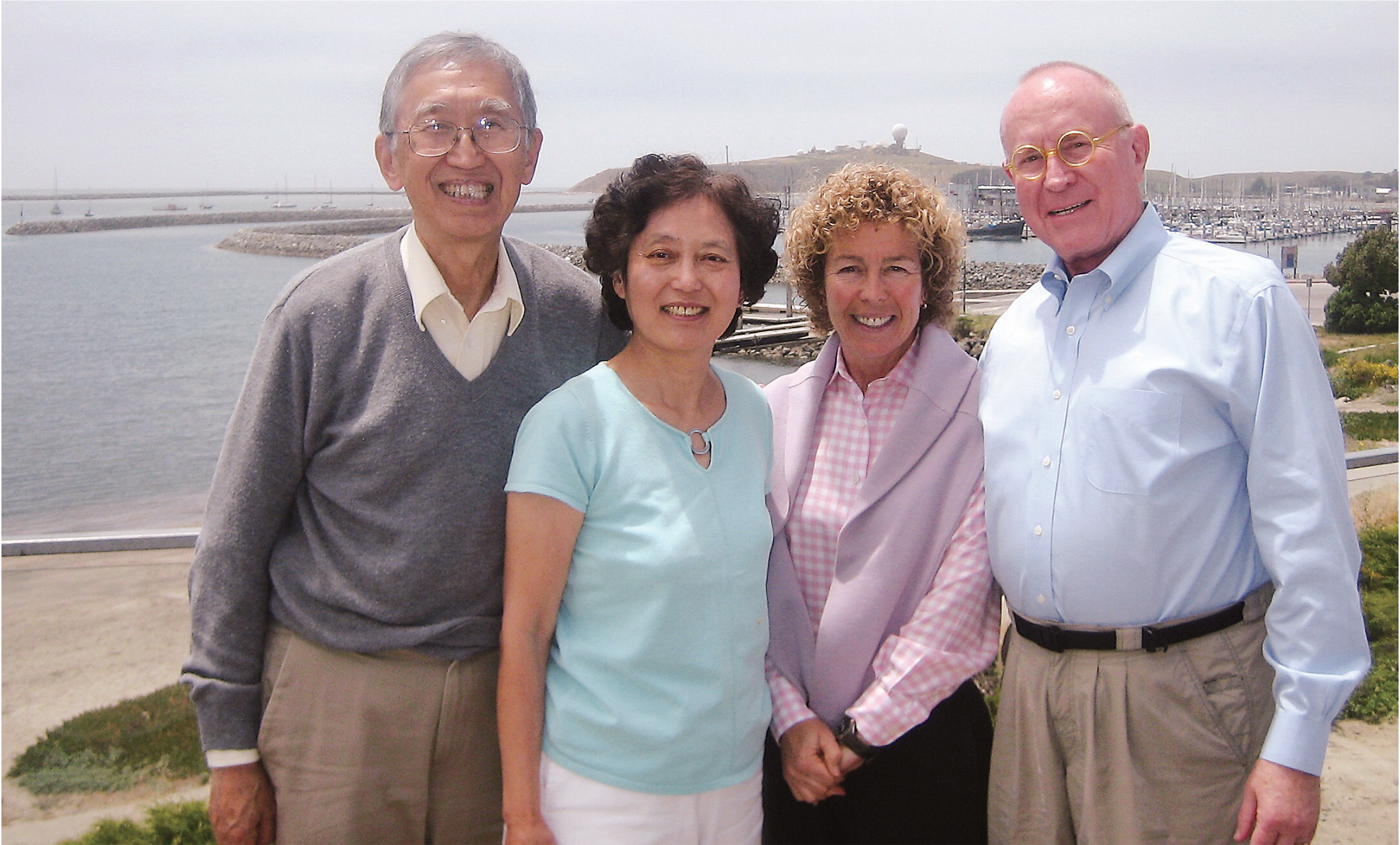
Rhodes had long lived on the East Coast. Later he moved to Half Moon Bay, in California, not far from us. To thank him for his generosity, my husband and I invited him and his wife Ginger to dinner at a Chinese restaurant in Foster City in May 2010. The first time I met Rhodes I was struck by his height and the gravity of his face — but as soon as the conversation began, I found him gentle indeed. Because of The Making of the Atomic Bomb, he knew many physicists; my husband had earned his Ph.D. at Harvard under the Nobel laureate Julian Schwinger and was himself a theoretical physicist, and the two of them spent the evening in talk of the great theoretical physicists of the time — Murray Gell-Mann, Richard Feynman, and others. They were so caught up in the conversation that we forgot to take a photograph; fortunately I had brought two of his books for him to sign. We met a second time in June 2011, after Pegasus had brought out my memoir. To celebrate, my husband and I invited him and his wife to lunch at a restaurant in Half Moon Bay. The restaurant sat on the rocks above the sea; through the windows we could see the waves of the Pacific. Before we left, we took a photograph outside the restaurant, the sea behind us. Rhodes and I exchanged letters until 2015. I will never forget his encouragement and his support — without them my memoir would not have come out as it did.
In his foreword he wrote: “I had met Iris Chang. Now I have come to know her parents as well; and I can see in them the source of the wisdom and the courage of Iris Chang. In this brave memoir you will come to know an extraordinary young woman and her family, and to know her life. As the French structuralist anthropologist Claude Lévi-Strauss once said, the loss of someone close to us, or the loss of a writer or an artist who has moved us, is an irreparable absence — as if a particular rose had ceased forever to bloom, and its scent could no longer be found. A memoir cannot bring Iris Chang back; but it can at least let us feel her presence again. And that presence will always be true — full of courage, full of conviction, full of life.”
In a year filled with discussion of the film Oppenheimer, I think back, again and again, to him. It was The Making of the Atomic Bomb that laid down for the lay reader what the building of the bomb meant. How fortunate I am that he wrote the foreword to my memoir. He is the same age as my husband, born in 1937; his birthday is approaching, and I offer this piece to him as a birthday gift, in token of my gratitude.
- Ying-Ying Chang is the mother of Iris Chang. She holds a Ph.D. in biochemistry from Harvard. In 2011 she published her English memoir of her daughter, The Woman Who Could Not Forget; the Chinese translation, Iris Chang: The Woman Who Could Not Forget History, was published in both simplified and traditional editions in 2012.